
Clear dead stock
without killing margins
Automate markdowns with controlled step-down pricing. Find the highest price your products will sell at, not the lowest. Recover margin from every slow-moving SKU.

30%+
of retail inventory gets marked down yearly
53%
of markdown costs from misjudged decisions
24/7
automated repricing, no manual work
How the markdown algorithm works
A controlled step-down approach that finds the highest price at which a product will sell, not the lowest.
Step 1
Set the rules once
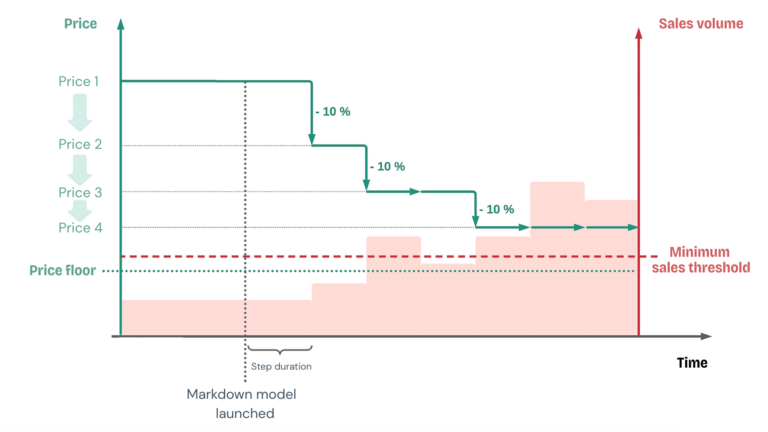
Define parameters: minimum sales, step duration, discount %, and a price floor not to cross.
Step 2
Price drops
The algorithm reduces the current price by the defined percentage and starts the clock on the evaluation period.
Step 3
Observation
During the step period, the model tracks how many transactions the product generates.
Step 4
Doesn't sell enough?
If minimum sales aren't reached on time, the price drops again. This repeats until the product sells or hits the floor.
Step 5
Model resets
When a step is successful, the algorithm holds the price and restarts the evaluation. Price is fixed where it works.
Why step-down beats one-shot discounting
The traditional approach to clearance is a single, often aggressive discount. Drop the price by 40% and move the stock. But this ignores a critical question: would it have sold at 25%?
Price discovery, not guessing
Each step is a controlled test. The algorithm works through price levels systematically, so you capture every dollar of margin the market will bear.
Maximize margin recovery
Products that could sell at 20% off don't end up at 40% off. The model finds and holds the optimal price automatically.
Scale across your catalog
With hundreds or thousands of SKUs in clearance, manual management is impossible. The algorithm handles every product individually, 24/7.
Four settings. Full control.
Configure the model once and let it run. Each parameter shapes how aggressively or conservatively the algorithm clears your inventory.
Minimum sales threshold
How many transactions should a product generate during one step to prove the current price works? Set this too low and the model holds underperforming prices. Too high and it keeps discounting products that are selling fine.
Maximum step duration
How many days does the algorithm wait before making its decision? Shorter windows force faster clearance. Longer windows give seasonal products room to find their audience.
Step size
The percentage drop at each reduction. Smaller steps (5-8%) are more precise but slower. Larger steps (10-15%) clear inventory faster but risk skipping the optimal price.
Price floor
The absolute limit. Set it based on your purchase cost or recommended retail price. The algorithm will never go below this number, no matter how many steps it takes.
"Disivo improved our pricing strategy, identifying and fixing weak spots. We increased profitability in clearance sales by 62% using their intelligent markdown model."
Marek Vaniš
CMO

Let's chat!
What happens next? Our pricing consultant will get in touch with you to discuss your specific needs. We usually respond within one business day.
Explore Disivo pricing models
Markdown is just one tool in the toolbox. Disivo offers multiple pricing models to cover every scenario in your catalog.
Optimize prices based on real demand signals
The Margin Maximization Automation ("Price Jumps") model adjusts prices up or down based on actual sales performance. If a product sells well, the price goes up. If it doesn't, it comes down automatically.
-
Bi-directional price optimization
-
Works with low sales volumes
-
Demand-responsive adjustments
-
Independent evaluation per product
Stay competitive with a immediate market price decisions
Automatically track competitor prices and adjust yours based on the rules you define. Stay competitive on key products while protecting margins where you can.
-
Real-time competitor monitoring
-
Category-level strategies
-
Rule-based repricing in your control
-
Margin guardrails
Smart Price Elasticity Testing
The Optimal Price Model uses price elasticity testing to discover, maintain, and continuously validate the best margin level. It runs automated A/B tests comparing two price tiers, collects impression and sales data, and statistically determines which performs better and then iterates.
-
Automated A/B price testing
-
Best for high-volume products (200+ sales/month)
-
Statistical evaluation at 90% confidence
-
Continuous re-optimization over time
Clear dead stock without killing margins
Automate markdowns with controlled step-down pricing. The algorithm finds the highest price a product will sell at, holds when it works, and never drops below your floor.
-
Step-down price discovery
-
Price floor protection
-
Automatic hold on working prices
-
Transaction-based evaluation
Manufacturers: Monitor Reseller Prices
As a manufacturer or distributor, track the prices your resellers are actually selling at to ensure brand consistency and support channel relationships.
Retailers: Strengthen Supplier Negotiations
As a buyer, use competitor price data as a concrete basis when negotiating purchase prices with your suppliers.
Monitor Recommended Price Compliance
Track whether resellers are honoring your recommended retail prices, keeping your pricing strategy intact across the channel.
Tab Content
This is a basic text element.
Tab Content
This is a basic text element.
Tab Content
This is a basic text element.






















Turn dead stock into margin recovery
Less time spent manually repricing. More margin recovered from slow-moving SKUs. Full pricing control with guardrails built in.