
Stop guessing prices. Let demand do the math.
Selling fast? Price jumps up. Selling slow? Price steps down. The Margin Maximization Model tunes every SKU to its real-world demand.

Up & Down
bi-directional pricing driven by real sales
Low volume
works without large statistical samples
Per-SKU
every product evaluated independently, 24/7
How the Price Jumps algorithm works
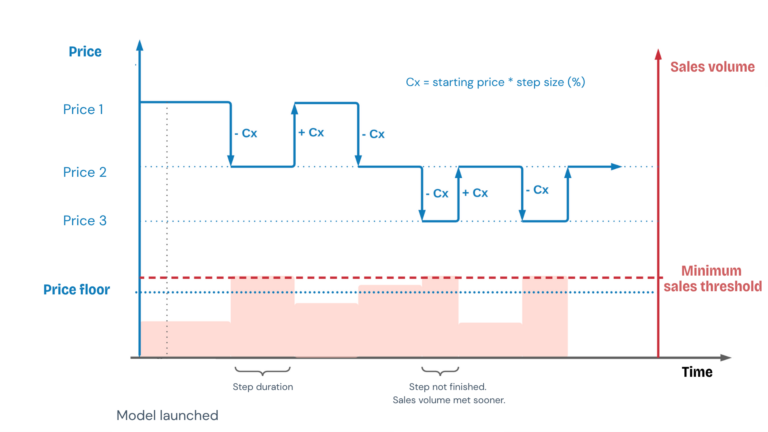
A bi-directional pricing model that uses sales velocity to push prices toward the level where every SKU performs best.
Step 1
Pick a setup
In automatic mode, Disivo estimates the optimal jump size and target sales per product from historical data. In manual mode, you set every parameter yourself.
Step 2
Monitoring
For every product, the algorithm tracks how many transactions happen during the jump window.
Step 3
Hit the target?
If a product reaches its minimum sales count before the jump period ends, the model doesn't wait. The price is increased to capture more margin while demand is hot.
Step 4
Doesn't sell enough?
If sales fall short by the end of the jump, the price drops by one step to stimulate demand, but never below the price floor you defined.
Step 5
Single SKU optimized
Products are optimized independently. One SKU may be jumping up while another steps down, so that each product's price matches its real demand.
Why Price Jumps beat typical re-pricing
Most catalogs sit at a price somebody picked months ago. Some products are too cheap and selling out losing margin. Others are too expensive and quietly stagnating. Price Jumps fixes both directions, automatically. If a product is selling, the price goes up. If it isn't, the price comes down.
Built for low sales volumes
Unlike statistical A/B testing models, Price Jumps doesn't need hundreds of sales per month to act. It works on long-tail SKUs where data is scarce but margin still matters.
Captures "up", not just discounting
When demand is strong, the price jumps up immediately on the next export. You are not leaving margin on the table whenever a product is underpriced.
Independent, per-product logic
Every SKU is evaluated on its own. One product can climb while another drops in the same run, so the catalog sets the right price product by product.
Four settings. Full control.
Configure the model once and let it run. Each parameter shapes how aggressively or conservatively the algorithm tests your inventory.
Minimum sales threshold
How many transactions should a product generate during one step to prove the current price works? Set this too low and the model holds underperforming prices. Too high and it keeps discounting products that are selling fine.
Maximum step duration
How many days does the algorithm wait before making its decision? Shorter windows force faster clearance. Longer windows give seasonal products room to find their audience.
Step size
The percentage drop at each reduction. Smaller steps (5-8%) are more precise but slower. Larger steps (10-15%) clear inventory faster but risk skipping the optimal price.
Price floor
The absolute limit. Set it based on your purchase cost or recommended retail price. The algorithm will never go below this number, no matter how many steps it takes.
It's about a purchase decision
The model evaluates transactions, not units. One order with 3 units still counts as one sale because it represents one purchase decision.
One thing to watch
The model assumes its recommendations actually reach your store. If you skip a recommended price change (with a manual override etc.) the jump logic loses its feedback loop. Use automatic exports so every decision flows through.
"We always wanted to test different prices for our products, but manual repricing was too tedious. After the first month of automated repricing, the results were amazing."
Jakub Kocourek
Product manager, Gastrozone
Let's chat!
What happens next? Our pricing consultant will get in touch with you to discuss your specific needs. We usually respond within one business day.
Explore Disivo pricing models
Price Jumps is just one tool in the toolbox. Disivo offers multiple pricing models to cover every scenario in your catalog.
Clear dead stock without killing margins
Automate markdowns with controlled step-down pricing. The algorithm finds the highest price a product will sell at, holds when it works, and never drops below your floor.
-
Step-down price discovery
-
Price floor protection
-
Automatic hold on working prices
-
Transaction-based evaluation
Stay competitive with a immediate market price decisions
Automatically track competitor prices and adjust yours based on the rules you define. Stay competitive on key products while protecting margins where you can.
-
Real-time competitor monitoring
-
Category-level strategies
-
Rule-based repricing in your control
-
Margin guardrails
Smart Price Elasticity Testing
The Optimal Price Model uses price elasticity testing to discover, maintain, and continuously validate the best margin level. It runs automated A/B tests comparing two price tiers, collects impression and sales data, and statistically determines which performs better and then iterates.
-
Automated A/B price testing
-
Best for high-volume products (200+ sales/month)
-
Statistical evaluation at 90% confidence
-
Continuous re-optimization over time
Optimize prices based on real demand signals
The Margin Maximization Automation ("Price Jumps") model adjusts prices up or down based on actual sales performance. If a product sells well, the price goes up. If it doesn't, it comes down automatically.
-
Bi-directional price optimization
-
Works with low sales volumes
-
Demand-responsive adjustments
-
Independent evaluation per product
Manufacturers: Monitor Reseller Prices
As a manufacturer or distributor, track the prices your resellers are actually selling at to ensure brand consistency and support channel relationships.
Retailers: Strengthen Supplier Negotiations
As a buyer, use competitor price data as a concrete basis when negotiating purchase prices with your suppliers.
Monitor Recommended Price Compliance
Track whether resellers are honoring your recommended retail prices, keeping your pricing strategy intact across the channel.
Tab Content
This is a basic text element.
Tab Content
This is a basic text element.
Tab Content
This is a basic text element.























Optimal price for every product
Less time spent manually repricing. More margin recovered. Full pricing control with guardrails built in.