
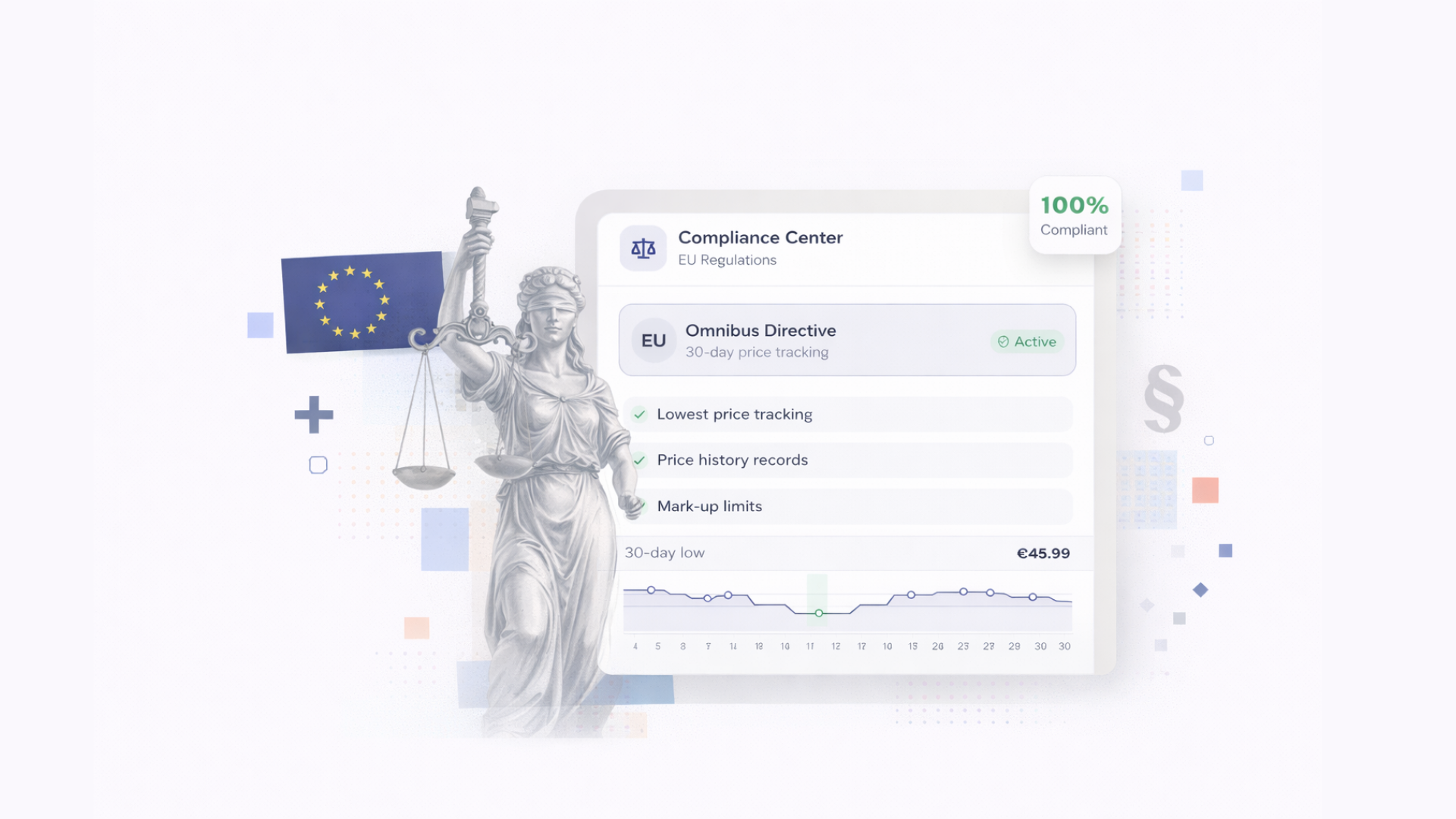
The EU Omnibus Directive rewrote the rules for e-commerce discounting. Three years later, more than half of European retailers still get it wrong. That gap between regulation and execution is where pricing managers lose money, trust, and sleep.
Every pricing manager knows the drill. Black Friday approaches. Marketing wants aggressive discounts. The category team pushes for bulk markdowns across 5,000+ SKUs. Someone in the room asks: “Are we sure these discounts are calculated correctly?”
The EU’s Price Indication Directive (amended by the Omnibus Directive 2019/2161) requires every e-commerce discount to reference the lowest price the retailer actually charged during the 30 days before the promotion. Simple rule. Massive operational headache.
Here is what the numbers say. In 2025, 54% of monitored online stores in the EU were found offering discounts that breached the Price Indication Directive. That is up from 43% the year before. The European Commission now tracks 136,931 products from 1,556 retailers across 24 member states using AI-powered web scraping tools, feeding a continuous stream of evidence to national enforcement agencies.
54% of EU online stores breached the Omnibus Directive in 2025. Up from 43% the year before.
Apify, Nov 2025
This is not a paperwork issue. It is an active enforcement priority. France fined SHEIN €40 million in 2025 for deceptive discount pricing. Investigators found that 57% of SHEIN’s advertised promotions offered no real price reduction at all, and 11% were actually price increases disguised as discounts. Spain sanctioned MediaMarkt, Carrefour, and PC Componentes for inflating prices before Black Friday 2023 and presenting the reductions as genuine deals.
The Dutch Authority for Consumers and Markets (ACM) now runs structural price monitoring of online shops and has moved from warnings to fines. In Poland, non-compliance penalties reach up to 10% of annual turnover.
The EU floor is 4% of annual turnover. Poland goes to 10%.Italy caps at €10M nationally. The UK now matches Poland at 10% of global turnover. The 4% is the minimum, not the ceiling.
And the pressure is only increasing. In January 2026, regulatory analysts confirmed that EU price transparency sweeps will continue throughout 2026, coordinated by the Consumer Protection Cooperation (CPC) network. The EU’s 2030 Consumer Agenda, adopted in November 2025, explicitly names automated enforcement tools as a priority. Regulators are not just checking manually. They are scraping your website.
Why This Hits Pricing Managers Hardest
The Omnibus Directive does not just affect the legal team. It changes how pricing managers plan, schedule, and execute every promotional campaign.
The 30-day rule creates a planning constraint. If you run a “teaser” promotion two weeks before Black Friday, that lower price becomes the new baseline. Your headline Black Friday discount shrinks. Run a flash sale in October, and your November campaign math changes. Every pricing decision in the 30-day window affects the next one.
Bulk discounting gets complicated fast. A pricing manager running a seasonal campaign across 3,000 SKUs cannot manually check the 30-day price history of each product. That is 3,000 lookups, 3,000 compliance verifications, and 3,000 potential violations. Multiply that by the number of campaigns per quarter.
RRP (Recommended Retail Price)-based discounts are a trap. Many retailers still calculate their “strikethrough” price from the manufacturer’s recommended retail price. The Omnibus Directive does not ban showing the RRP. But if the discount percentage is calculated from the RRP instead of the retailer’s own lowest price in 30 days, that is a violation. The ACM in the Netherlands explicitly prohibits using the RRP as the crossed-out reference price.
For companies selling electronics, outdoor gear, or pharma products with frequent supplier price changes, this gets especially tricky. Purchase prices shift. Competitor-driven repricing moves your selling price daily. The 30-day minimum is a moving target across your entire catalog.
Stop treating Omnibus compliance as a legal checkbox. Start treating it as a pricing workflow.
1. Automate the 30-day price floor calculation. Every product entering a promotional campaign needs its lowest selling price from the past 30 days calculated automatically. Not from a spreadsheet someone exported last week. From live data, updated continuously.
Disivo solves this at the system level. When a product is added to a marketing action, Disivo automatically calculates and exports the lowest prior price (the PRIORPRICE_VAT field) for every product in the campaign. It filters out periods when the product was already in another promotional action, so the 30-day baseline reflects the actual “regular” selling price. This logic was built in consultation with legal advisors interpreting Article 6a of the directive. See the full technical setup.
2. Plan campaigns around the 30-day window, not against it. The best-run pricing teams now build their promotional calendars with the directive in mind. They space out flash sales. They avoid running competing campaigns on overlapping SKUs within the 30-day buffer. That is not a limitation. That is pricing discipline that protects your margins and your brand.
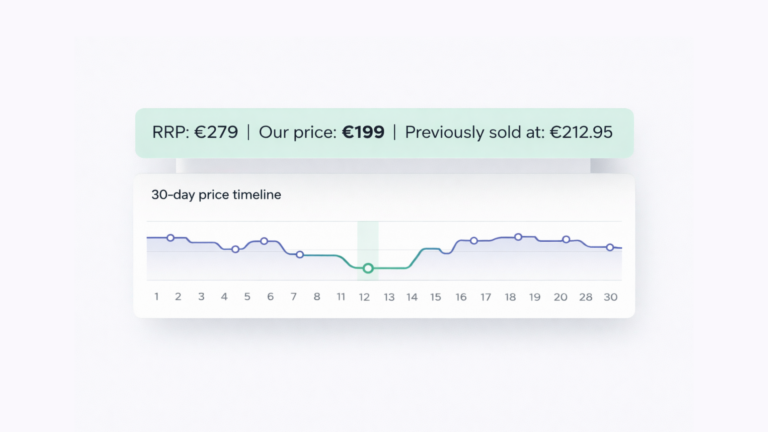
3. Separate RRP (Recommended Retail Price) display from discount calculation. You can still show the manufacturer’s RRP to give customers context. But the percentage discount and the crossed-out “was” price must use your own lowest price from the past 30 days. Label it clearly: “RRP: €279. Our price: €199. Previously sold at: €212.95.” Transparent labeling protects you legally and builds trust.
75% of Portuguese consumers believe stores inflate prices before sales.
Euroconsumers, Nov 20255
4. Build compliance into bulk operations. When applying a 20% markdown across an entire product category, your system needs to flag products where the 30-day floor would make the advertised discount mathematically impossible. If a product’s lowest price in 30 days was already at or below the planned promo price, that is not a valid discount. Catch it before it goes live.
The fine risk is real. 4% of annual turnover is serious money. But the trust erosion might cost more. A 2025 Euroconsumers survey found that 75% of Portuguese consumers and 53% of Italian consumers believe stores inflate prices before sales events. Price skepticism is the norm. It takes one viral post about fake discounts to undo a year of brand building.
Retailers who automate Omnibus compliance are not just avoiding risk. They are making a statement: our discounts are real. That is a competitive advantage in a market where consumer cynicism is at an all-time high.
The Omnibus Directive is not going away. EU enforcement is accelerating, with AI-powered monitoring, bigger fines, and cross-border coordination. The upcoming Digital Fairness Act (expected Q4 2026) will likely tighten the rules further.
Pricing managers who treat this as a technology problem to solve once, rather than a manual process to repeat forever, will spend less time on compliance and more time on strategy. Automate the 30-day price floor. Build it into your campaign workflows. Make your discounts bulletproof.
Book a Demo to see how Disivo handles Omnibus compliance for promotional campaigns automatically.
Apify / European Commission, November 2025
https://blog.apify.com/how-web-scraping-ai-and-the-eu-have-come-together-to-sweep-away-fake-discounts-in-europe/
Euro Weekly News, July 2025
https://euroweeklynews.com/2025/07/05/shein-fined-e40-m-for-fake-discounts/
European Commission, May 2025
https://commission.europa.eu/live-work-travel-eu/consumer-rights-and-complaints/enforcement-consumer-protection/coordinated-actions/market-places-and-digital-services_en
Hogan Lovells, 2025
https://www.hoganlovells.com/en/publications/false-black-friday-discounts-six-companies-sanctioned-and-key-lessons-for-the-retail-sector
Euroconsumers, November 2025
https://www.euroconsumers.org/black-friday-2025-quality-deals-without-discount-drama/
Dudkowiak & Putyra, January 2026
https://www.dudkowiak.com/e-commerce-law-in-poland/e-commerce-regulation-in-europe/
Wilson Sonsini / The Data Advisor, January 2026
https://www.wsgrdataadvisor.com/2026/01/2026-year-in-preview-regulatory-consumer-protection-trends-for-companies-to-watch-out-for/
Maverick Advocaten, 2025
https://www.maverick-law.com/en/blogs/webshops-beware-acm-may-impose-high-fines-for-use-of-fake-discounts.html
Baker McKenzie / Lexology, February 2026
https://www.lexology.com/library/detail.aspx?g=7e82ccc1-4914-4284-94a3-48dc22792ff6
Bird & Bird, 2025
https://www.twobirds.com/en/insights/2025/global/transparency-of-price-reductions-a-closer-look-at-the-legal-framework-in-the-eu
Canella Camaiora, May 2025
https://www.canellacamaiora.com/consumer-protection-the-consequences-for-those-who-fail-to-comply-with-the-omnibus-directive/
Osborne Clarke, 2023
https://www.osborneclarke.com/insights/huge-gdpr-style-fines-loom-breaches-consumer-law-across-europe