AI chatbots are no longer just answering questions. They are comparing prices, recommending products, and closing sales. For pricing managers, this changes everything.
In 2025, something changed in e-commerce that many pricing teams missed. Consumers stopped browsing 20 tabs to compare products. Instead, they asked a chatbot. One question, one answer, one or two product recommendations. Done.
Almost half of US consumers (49%) used AI tools for shopping at some point in 2025, according to a PartnerCentric survey of over 1,000 consumers. The primary reason? Finding the best price. 55% of AI shoppers said price comparison was their top motivation. Not curiosity. Not product discovery. Price.
55% of AI shoppers used chatbots primarily to find the best price.
PartnerCentric, Dec 2025
Traffic from AI-powered chat tools to US retail sites grew 4,700% year-over-year by July 2025, according to Adobe Digital Insights. That is not a typo. And those visitors are not casual browsers. Adobe found they spend 32% more time per visit, view 10% more pages, and bounce 27% less than visitors from traditional search.
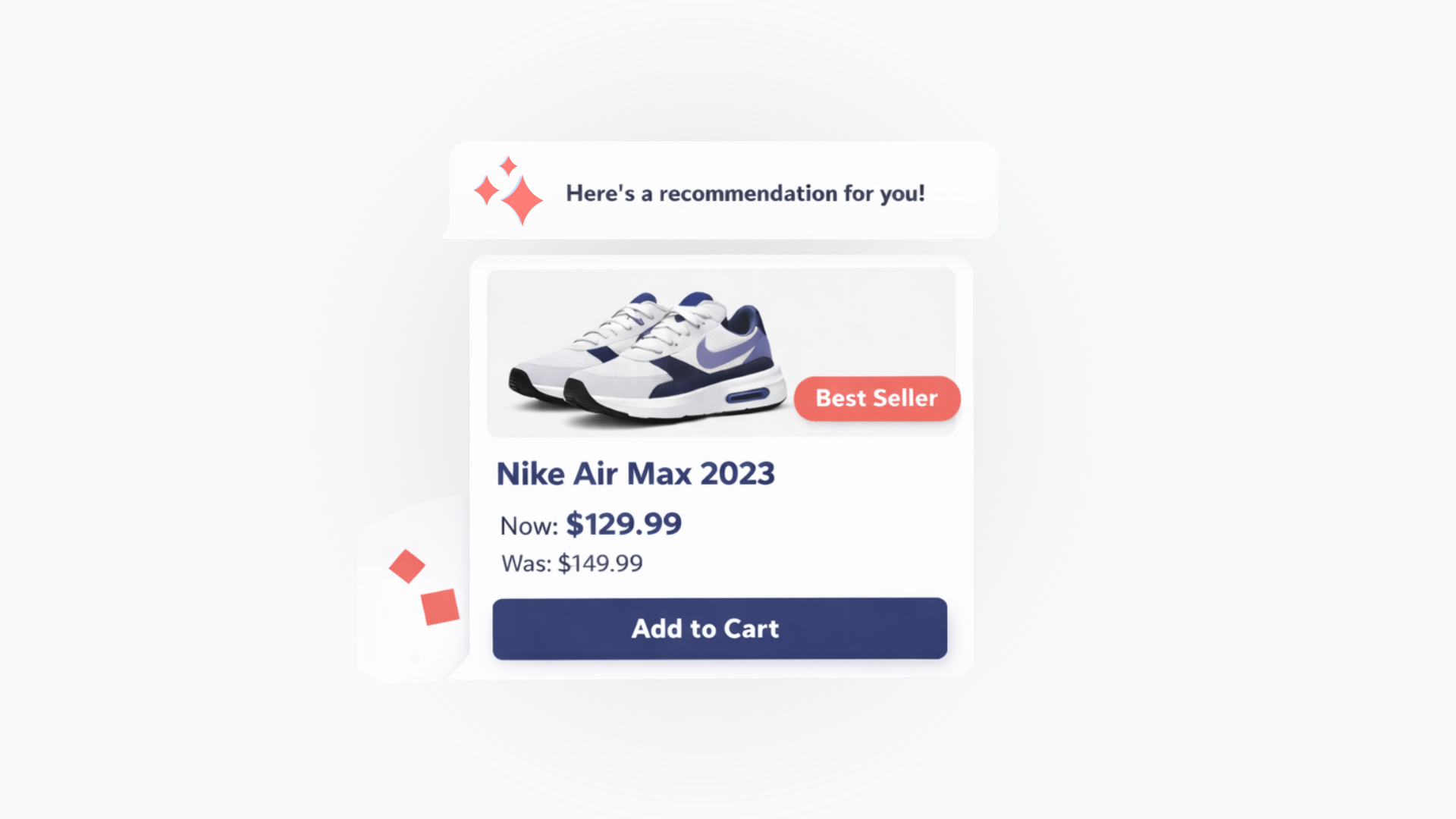
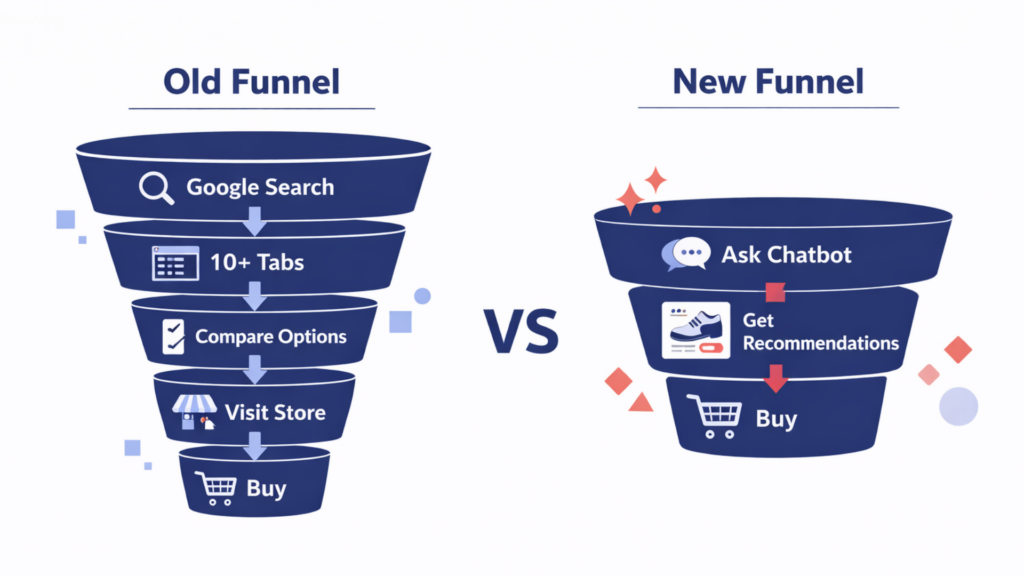
The funnel is collapsing. A shopper no longer types “best running shoes” into Google and browses ten results. They tell ChatGPT: “Recommend a lightweight running shoe under 120 dollars for wide feet.” The AI returns two or three options. The shopper picks one. In some cases, they buy without leaving the chat window.
This is not a concept demo. ChatGPT rolled out its Instant Checkout feature in September 2025 for Shopify merchants, powered by Stripe. Target, Walmart, Etsy, and Instacart followed. Perplexity launched its own Instant Buy with PayPal integration for Black Friday 2025, tapping into PayPal’s 430+ million active accounts.
Meanwhile, Google announced its Universal Commerce Protocol in January 2026, partnering with Walmart, Target, Shopify, and 20+ other retailers. McKinsey projects AI-influenced commerce will reach 3 to 5 trillion dollars globally by 2030.
The numbers on conversion tell the story. Shoppers who engage with AI during a session convert at 12.3%, nearly four times the 3.1% rate of those who do not, according to Neuwark’s analysis of 2025 conversational commerce data. AI-driven revenue per visit rose 84% from January to July 2025 alone.
12.3% conversion rate for AI-assisted shoppers vs. 3.1% without AI.
Neuwark, 2025
However, this shift is not linear. Forrester’s March 2026 ConsumerVoices survey found that completing a purchase within an AI chat remains the least-adopted use case among regular answer-engine users. Shoppers still research in chat but often finish buying on the retailer’s site. OpenAI itself recently pulled back from native checkout, redirecting shoppers to merchant websites instead.
What does this mean? The AI chat is becoming the decision layer. The place where price gets evaluated, compared, and judged. Even when the final click happens on your site, the price decision was already made in the chat.
If your pricing strategy was built for a world where shoppers browse, compare, and decide on their own timeline, it needs an update. Here is what changes when AI mediates the buying decision.
AI chatbots do not have brand loyalty. They do not get distracted by hero banners or lifestyle photography. They read structured data: price, specs, reviews, availability. When a shopper asks ChatGPT for the best option, the AI pulls from product feeds across the web and ranks on value. If your price is off by 3%, you are not in the shortlist.
This makes competitor tracking more critical than ever. Not weekly. Not daily. Continuous. Your price position against key competitors determines whether AI surfaces your product or skips it entirely.
In the old model, you could adjust prices weekly and stay competitive. In the AI-mediated model, the chatbot runs a fresh comparison every time a shopper asks. If a competitor dropped their price two hours ago, the AI already knows. Your stale price is now a losing price.
Manual repricing was already too slow for many SKUs. Now it becomes a direct revenue risk. Automatic repricing across your full catalogue, not just top sellers, is the baseline. Anything less means you are invisible to AI-driven shoppers on the SKUs that matter.
Here is the trap. AI shoppers are price-sensitive by design. 55% use chatbots specifically to find the cheapest option. If your only response is to race to the bottom, margins collapse.
Smart pricing managers will not play that game. Instead, they will segment aggressively. Products where you have unique positioning or exclusive supply get protected margins. Commodity SKUs get competitive, dynamic pricing that responds to market signals in real time. Clearance inventory gets intelligent markdown automation that prevents over-discounting while clearing stock fast.
AI does not kill margins. Bad pricing strategy does. The winners will be teams that match price agility with margin discipline.
The shift to AI-mediated buying is not coming. According to PartnerCentric, 64% of consumers plan to use AI chatbots for shopping in 2026, with nearly 1 in 4 planning to make it their default shopping method. The window to prepare is closing.
64% of consumers plan to use AI chatbots for shopping in 2026. 1 in 4 will make it their default.
PartnerCentric, Dec 2025
Here is where to start:
Audit your product feed quality. AI chatbots pull from structured product data. If your titles are vague, descriptions thin, and specs missing, the AI cannot recommend you. This is the new SEO, and pricing managers need a seat at the table.
Increase repricing frequency and SKU coverage. Move from repricing top 20% of SKUs to 100% catalogue coverage. If an AI chatbot evaluates a long-tail product and your price is outdated, that sale goes to someone else.
Build pricing rules for the AI-first shopper. These buyers are value-driven and comparison-oriented. Design strategies that win on perceived value, not just lowest price. Bundle logic, smart promotions, and margin-aware dynamic rules all play a role.
Track your AI visibility. Only 12% of URLs cited by ChatGPT, Perplexity, and Copilot also rank in Google’s top 10, according to Ahrefs research from August 2025. Your Google rankings do not guarantee AI visibility. Start monitoring where and how your products appear in AI-generated recommendations.
Only 12% of URLs cited by AI chatbots also rank in Google’s top 10.
Ahrefs, Aug 2025
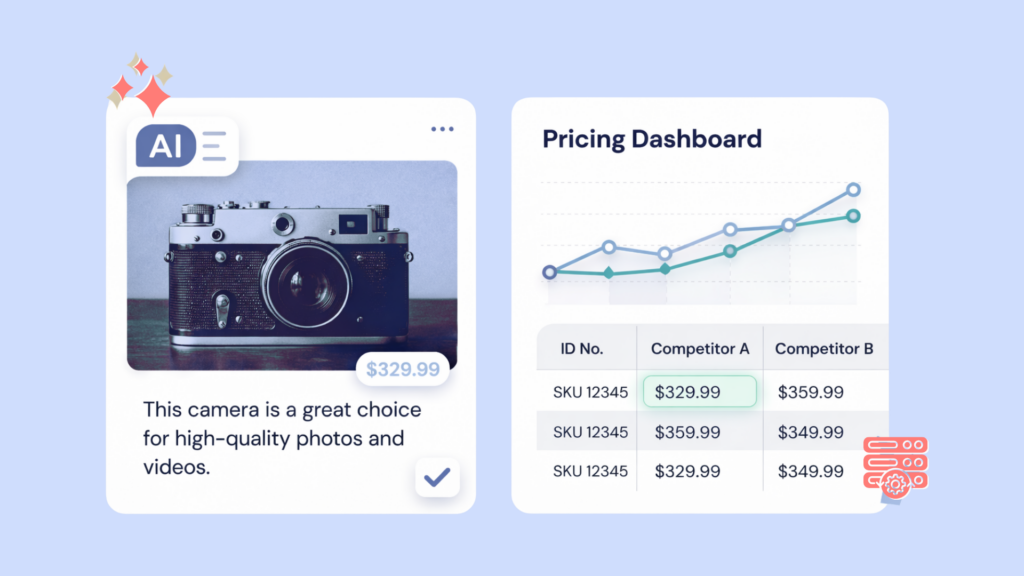
AI chat shopping is not replacing e-commerce. It is adding a new, powerful decision layer on top of it. A layer where price transparency is instant, comparison is automatic, and the margin for pricing errors shrinks to zero.
For pricing managers at mid-to-large e-commerce operations, this is not a threat. It is an opportunity. Teams that invest in real-time competitor tracking, automatic repricing with full SKU coverage, and intelligent margin protection will win the AI-mediated shopper. Teams that rely on manual processes and weekly price reviews will lose them.
The question is not whether your customers will use AI to buy. They already are. The question is whether your pricing is ready for it.
PartnerCentric (Dec 2025)
https://partnercentric.com/blog/ai-shopping-statistics-trends/
Adobe Digital Insights / Finovate (July 2025)
https://finovate.com/6-stats-pointing-to-the-rise-of-gen-ai-powered-shopping/
Neuwark (2025)
https://neuwark.com/blog/conversational-commerce-2026-ai-replacing-shopping-cart
Forrester (March 2026)
https://www.forrester.com/blogs/what-it-means-that-the-leader-in-agentic-commerce-just-pulled-back/
Opascope (Feb 2026)
https://opascope.com/insights/ai-shopping-assistant-guide-2026-agentic-commerce-protocols/
Ahrefs via Exposure Ninja (Aug 2025)
https://exposureninja.com/blog/ai-search-statistics/
Modern Retail (Jan 2026)
https://www.modernretail.co/technology/2026-will-prove-whether-ai-checkout-is-here-to-stay/
MIM Agency (March 2026)
https://www.agencymim.com/informational-resources/market-insights/chatgpt-shopping-and-the-new-logic-of-e-commerce-what-will-change-in-2026/