


Every e-commerce team knows the pain. Slow-moving SKUs sit in your warehouse for weeks. You slash the price by 30%. Nothing. You go to 50%. Suddenly it sells, but you just torched your margin on a product that might have moved at 35%.
That gap between “too expensive to sell” and “too cheap to profit” is where most retailers lose money. Not because they discount, but because they discount badly.
Over 30% of all retail inventory gets marked down every year. And according to industry research, 53% of unplanned markdown costs trace back to one root cause: misjudged inventory decisions. Not bad products. Not weak demand. Just poor timing and wrong discount depth.
This is the exact problem Disivo’s Markdown & Clearance Model was built to solve.
Manual markdowns work like a guess. A pricing manager looks at a product that hasn’t moved in three weeks, picks a discount percentage, applies it, and hopes for the best. If sales don’t pick up, they cut again. And again. Each cut is a reaction, not a strategy.
The result? Products that could have sold at 20% off end up at 40% off because nobody tracked whether the first discount was working. Or worse, a product starts selling just fine at the lower price, but nobody notices it should hold there instead of dropping further.
Manual repricing is slow. It’s inconsistent across categories. And with hundreds or thousands of SKUs in clearance at any given time, it’s impossible to manage well without automation.
The model uses a step-down approach. Instead of guessing the right clearance price in one shot, it finds it through controlled, automatic price reductions.
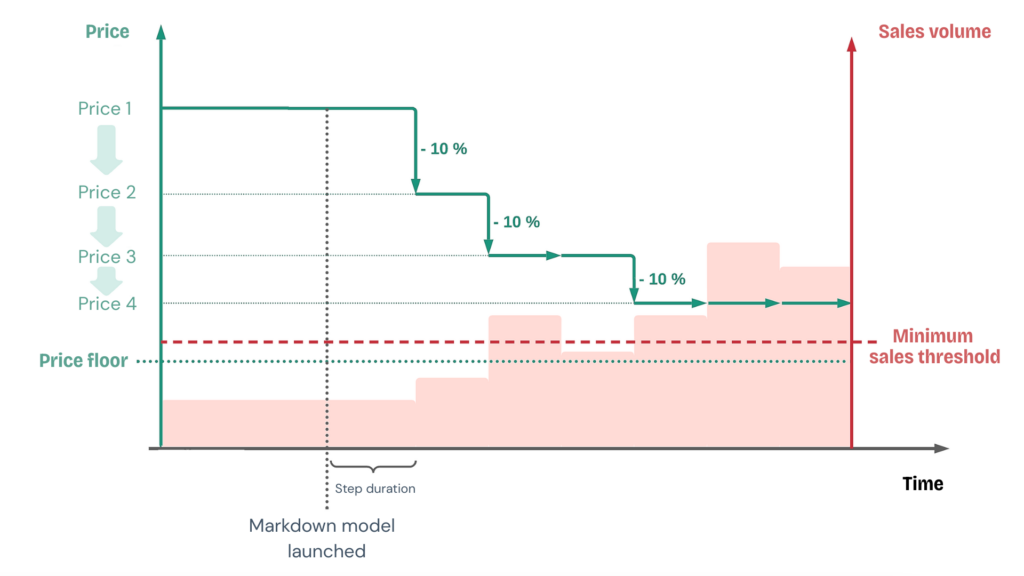
Here is the logic:
1. Set the rules once. You define four parameters: minimum number of sales per step, maximum step duration (how long to wait before the next drop), step size (how much to reduce each time), and a price floor (the limit the algorithm will never go below).
2. The algorithm drops the price by one step. It reduces the current price by your defined percentage and starts the clock.
3. It waits and watches. During the step period, the model tracks how many transactions the product generates. Not units sold, transactions. One order with 3 units counts as 1 sale.
4. If the product doesn’t sell enough, it drops again. The step expires, minimum sales weren’t reached, so the price falls by another step. This repeats until either the product starts selling or hits the price floor.
5. If the product sells enough, the model resets. This is the key. When a step is successful (minimum sales reached), the algorithm holds the price and restarts the evaluation period. The product stays at the price that works. No further discounting unless sales drop again.
This approach finds the highest price at which a product will sell. Not the lowest. That distinction is worth millions across a large catalog.
53% of unplanned markdown costs come from misjudged inventory decisions.
ImpactAnalytics, 2024
The traditional approach to clearance is a single, often aggressive discount. Drop the price by 40% and move the stock. But this ignores a critical question: would it have sold at 25%?
Disivo’s step-down model answers that question automatically. Each step is a controlled test. The algorithm works through price levels systematically, so you capture every dollar of margin that the market will bear.
Think of it as price discovery for dead stock. The product tells you what it’s worth through actual sales behavior, not through a pricing manager’s gut feeling at 4pm on a Friday.
Minimum sales threshold. How many transactions should a product generate during one step to prove the current price works? Set this too low and the model holds prices that aren’t really performing. Too high and it keeps discounting products that are selling fine.
Maximum step duration. How many days does the algorithm wait before making its decision? Shorter windows force faster clearance. Longer windows give seasonal products room to find their audience.
Step size. The percentage drop at each reduction. Smaller steps (5-8%) are more precise but slower. Larger steps (10-15%) clear inventory faster but risk skipping the optimal price.
Price floor. The limit. Set it based on your purchase cost or recommended retail price. The algorithm will never go below this number, no matter how many steps it takes.
With that much inventory moving through clearance cycles every year, getting the parameters right on your markdown model has a direct impact on annual margin performance.
The model is powerful, but it needs clean operating conditions. A few things to keep in mind:
Run automatic exports or approve price changes daily. The algorithm evaluates sales against the prices it recommends. If you override a recommended price outside of Disivo or delay exporting, the model loses its feedback loop. It’s tracking a price the product isn’t actually set to.
Delete the model after clearance is complete. When inventory sells out, end and remove the model. If you restock the same product later, the model remembers its last clearance price and picks up from there. That’s by design (it protects against feed interruptions), but it means a restocked product could start at a deeply discounted price if you forget to clean up.
Transaction count, not unit count. One customer buying 5 units in a single order registers as 1 sale. Keep this in mind when setting your minimum sales threshold. For products with high per-order quantities, adjust accordingly.
Clearance doesn’t have to mean margin destruction. The retailers winning at markdown strategy in 2025 are the ones who treat it as controlled price discovery, not panic discounting.
Disivo’s Markdown & Clearance Model automates that process. It steps prices down in controlled intervals, watches what sells, holds when it finds the right price, and never drops below your floor.
Less time spent manually repricing. More margin recovered from slow-moving SKUs. Full pricing control with guardrails built in.
Book a Demo to see how the markdown model works with your catalog. Or explore Disivo’s Pricing Academy for more on automatic repricing strategy.